
Rodents
Get a free estimate
Lorem ipsum dolor sit amet.

Services
Rodent control


Lorem ipsum dolor sit amet, consectetur adipiscing elit. Mauris dignissim aliquam nunc. Cras pretium, risus eget.
Rodents like rats and mice are more than just an annoyance — they carry bacteria, contaminate food, and cause serious damage by chewing through wires, insulation, and structural materials. Many homeowners first notice scratching in walls or ceilings, droppings in cabinets, or a strong, musty odor in hidden areas. Because rodents reproduce quickly and stay hidden, a small problem can turn into a full infestation faster than most people expect.
Hearing scratching in the walls or seeing droppings around your home? These are early warning signs of an active rodent infestation that won’t go away on its own. DIY traps and store-bought solutions rarely solve the root issue. Rodents are persistent and will continue entering your home as long as access points remain open. BugEvicta focuses on complete rodent control by removing the infestation and stopping how they’re getting inside.
Need fast help? Contact BugEvicta now for rodent inspection, removal, and exclusion support.
Our Rodent Control Process
1. Inspection
We identify rodent entry points, nesting areas, droppings, and gnaw marks to determine how far the infestation has spread inside and around your home.
2. Treatment Plan
We build a targeted strategy based on the rodent species, infestation level, and the specific entry points and conditions present on your property.
3. Elimination
We treat all active zones including attics, crawl spaces, walls, and the exterior perimeter where rodents are nesting and traveling.
4. Follow-Up
We provide ongoing monitoring and support to confirm rodents are fully eliminated and your home is protected from future entry.
Rodent Treatment Options We Use
Every infestation is different. We use the right method — or combination of methods — for your specific situation.
🪤 Snap Traps
Strategically placed in high-activity areas along walls, in attics, and in crawl spaces where rodents travel. Fast, effective, and results you can confirm.
☠️ Rodenticide Bait Stations
Tamper-resistant bait stations placed around the exterior of your home. Rodents enter, consume the bait, and the colony is eliminated at the source.
🚧 Exclusion & Entry Point Sealing
We identify and seal gaps, cracks, and openings in your foundation, roofline, and walls that rodents are using to get inside your home.
📦 Live Catch Traps
Humane trapping option that captures rodents alive for removal without the use of chemicals or rodenticide baits.
🔍 Monitoring & Ongoing Protection
Monitoring stations placed around your property to track rodent activity, confirm elimination, and catch new activity before it becomes a full infestation.
What Makes Our Rodent Control Different
- Targets the entire rodent population — not just what you can see
- Seals entry points to stop new rodents from getting inside
- Works on mice, rats, and other common rodents
- Protects attics, crawl spaces, walls, and living areas
- No guesswork — structured, proven approach
Where Rodents Hide and Enter
Rodents are not just in the walls. They hide and enter through:
- Gaps around pipes, utility lines, and the foundation
- Attics, crawl spaces, and wall voids
- Garage doors, rooflines, and vents
- Kitchen cabinets, under appliances, and pantry areas
- Openings as small as a dime for mice and a quarter for rats
If these entry points are not sealed and treated, rodents will keep coming back.
Get Rodents Handled the Right Way
Fast response. Complete treatment. No repeat problems.
Get a Fast Quote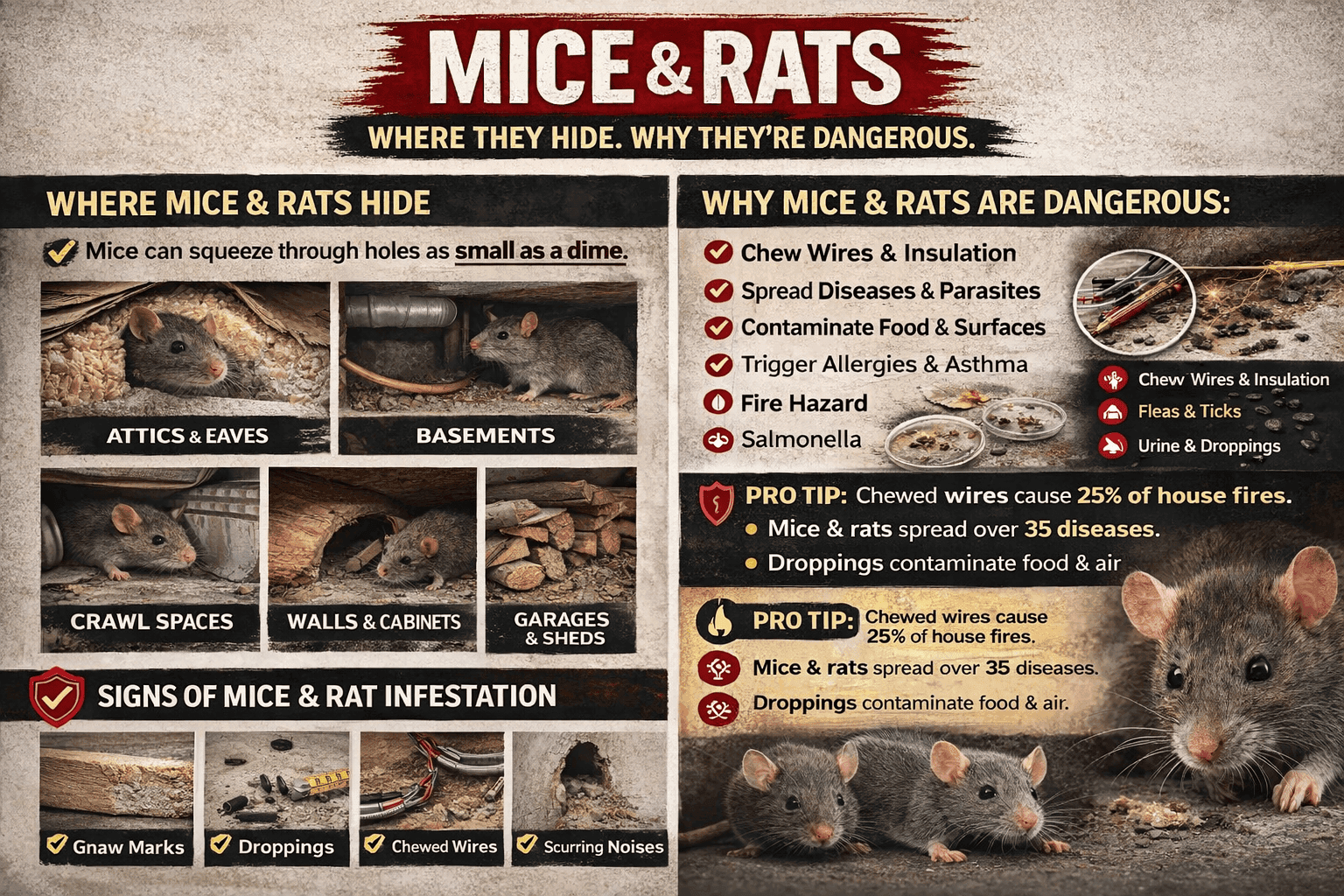
Common Rodent Control Questions We Hear From Homeowners
If you’re hearing scratching in the walls, seeing droppings, or noticing signs of mice or rats, these are the most common questions homeowners ask before scheduling rodent control.
How do I know if I have mice or rats?
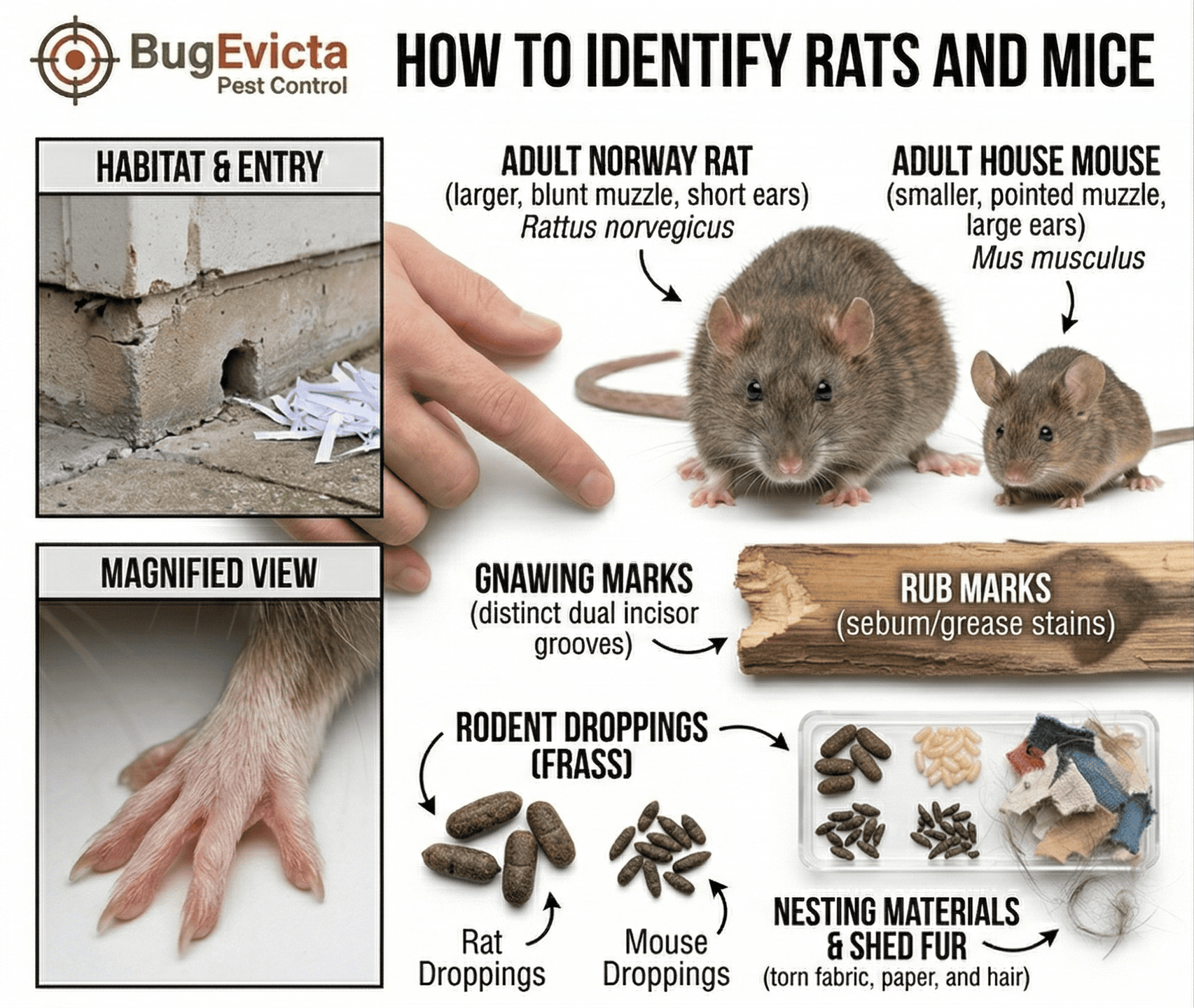
Common signs include droppings, scratching noises in walls or ceilings, gnaw marks on food or wiring, and nests made from shredded material. Mice are smaller and more active indoors, while rats are larger and often found in basements, attics, or crawl spaces.
Are rodents dangerous?
Yes. Rodents can spread bacteria, contaminate food, and damage wiring, insulation, and structural materials. In some cases, they can even create fire hazards by chewing through electrical wires.
How do rodents get into a home?
Rodents can enter through very small openings around foundations, vents, doors, and utility lines. Mice can squeeze through holes as small as a dime, making proper sealing and exclusion critical to stopping them.
Do rodents stay in one area or spread?
Rodents will travel throughout the home in search of food and nesting areas. What starts in one area can quickly spread into walls, attics, kitchens, and storage spaces if not addressed early.
How fast do rodents reproduce?
Mice reproduce very quickly, with a single pair capable of turning into dozens in a short time. Rats reproduce slower but still create large infestations if conditions are right. Fast action is key to preventing rapid growth.
How long does rodent treatment take?
Initial treatment can be done quickly, but full control depends on the size of the infestation and how many entry points need to be sealed. Effective rodent control includes removal, exclusion, and prevention.
Will one treatment get rid of rodents?
In some cases, yes—but without sealing entry points, rodents can return. Long-term control focuses on eliminating current activity and blocking access so new rodents cannot get inside.
How do I keep rodents from coming back?
Sealing gaps, removing food sources, and maintaining a protective barrier around the home are key. Professional exclusion and ongoing monitoring provide the best long-term protection. If you’re seeing signs of rodents, it’s best to act quickly before the problem grows.

Lorem ipsum dolor sit amet, consectetur adipiscing elit. Mauris dignissim aliquam nunc, sit amet pretium quam commodo vel. Cras pretium, risus eget tempus finibus, augue lorem fringilla dolor, sit amet eleifend nisi odio sit amet diam.
Esther Davidson