
Reactive pest treatment: real solutions for Illinois homes
TL;DR:
- Reactive pest treatment responds to active infestations for quick pest elimination.
- Methods include chemical sprays, baits, traps, and professional interventions based on pest type.
- Combining reactive treatment with prevention strategies ensures long-term protection and reduces recurrence.
When pests show up uninvited, most Illinois homeowners grab whatever spray is under the sink and hope for the best. That instinct is understandable, but it often leads to frustration, wasted money, and pests that keep coming back. Reactive pest treatment is a specific, targeted approach to handling active infestations, and it works very differently from the scheduled prevention programs many people picture when they think of pest control. This guide breaks down exactly what reactive treatment means, which methods actually work, and how to turn a one-time emergency response into lasting protection for your home.
Table of Contents
- What is reactive pest treatment?
- Types of reactive pest treatments for Illinois homes
- Pros and cons of reactive pest treatments
- Integrating reactive treatment with long-term prevention
- Why most homeowners misuse reactive pest treatment
- Find fast, reliable pest control for your Illinois home
- Frequently asked questions
Key Takeaways
| Point | Details |
|---|---|
| Reactive vs. preventive approaches | Reactive treatment addresses immediate pest problems while preventive care stops infestations from returning. |
| Professional help offers reliability | Professional treatments yield more consistent results than most consumer DIY solutions. |
| Integrated strategies work best | Combining reactive action with ongoing prevention is the key to lasting pest-free homes. |
| Cockroach baits: variable results | Lab tests show >80% cockroach mortality, but home outcomes are unpredictable with consumer products. |
What is reactive pest treatment?
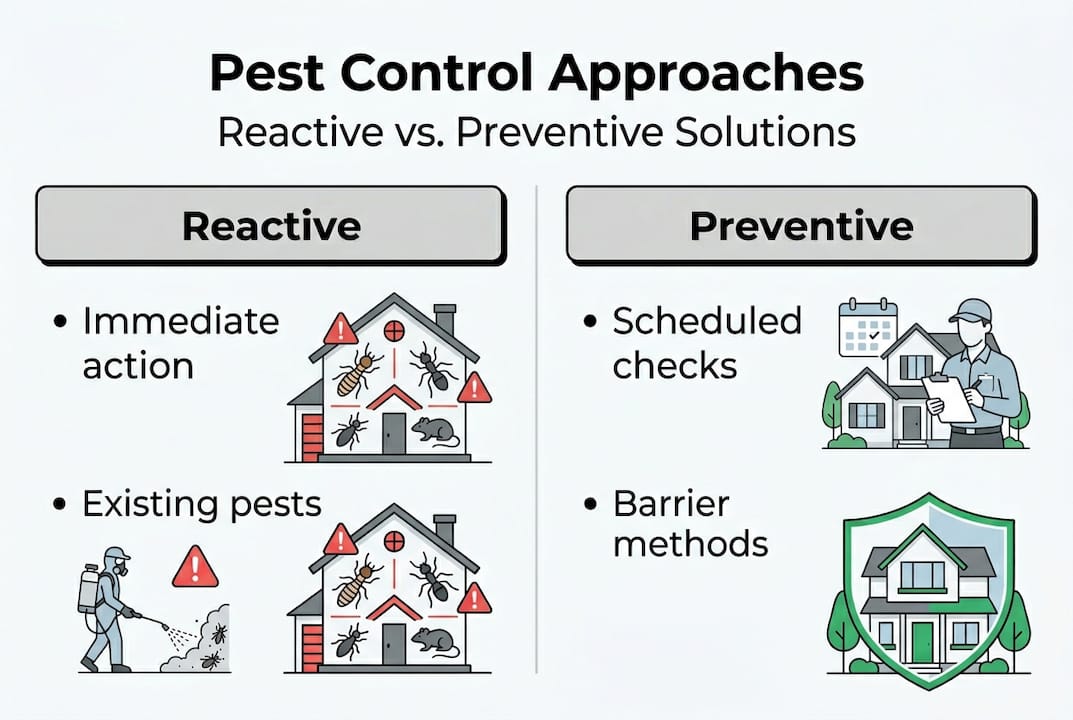
Reactive pest treatment means responding to a pest problem that is already happening. You see roaches in your kitchen, mice in your walls, or a trail of ants crossing your floor, and you need them gone now. This is the opposite of proactive or preventive pest control, which focuses on stopping pests before they ever get inside.
The distinction matters more than most people realize. Preventive programs involve regular inspections, barrier treatments, and habitat modifications scheduled throughout the year. Reactive treatment, by contrast, is triggered by a visible, active infestation. The goal is fast elimination of the existing population.
Illinois homeowners commonly need a reactive approach because of the state’s climate. Cold winters push rodents indoors looking for warmth. Hot, humid summers accelerate cockroach and ant activity. Sudden changes in weather can send pests scrambling into your home with very little warning. By the time you notice them, the infestation may already be well established.
Timing is everything with reactive treatment. The longer you wait, the larger the population grows and the harder it becomes to eliminate completely. A small ant colony spotted in spring can become a major structural problem by midsummer if ignored. The same principle applies to roaches, which can reproduce rapidly under the right conditions.
Common situations that call for reactive pest treatment include:
- A sudden ant invasion along baseboards or in the kitchen
- Cockroach sightings, especially during daylight hours (a sign of overcrowding)
- Rodent droppings, gnaw marks, or scratching sounds in walls
- Termite swarmers appearing near windows or doors
- Mosquito pressure spiking after heavy rain
Pro Tip: If you are seeing pests during the day when they are normally nocturnal, that is often a sign the infestation is large enough that competition for resources is forcing them out into the open. Do not wait to act.
Understanding what reactive treatment is also means recognizing what it is not. It is not a substitute for general pest control programs, but it is often the necessary first step before any long-term plan can be effective.
Types of reactive pest treatments for Illinois homes
Once you know you have an active infestation, you have several options. The right choice depends on the pest, the severity of the problem, and whether you want to handle it yourself or bring in a professional.
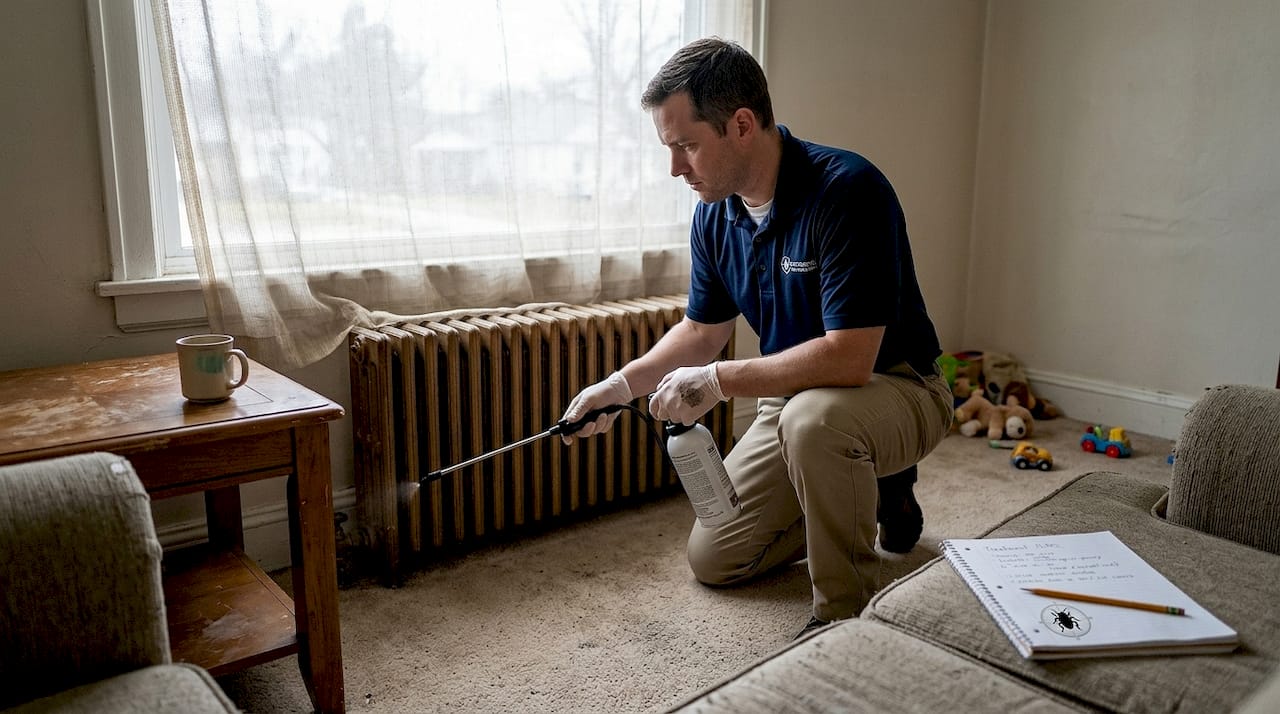
The main reactive treatment methods include:
- Chemical sprays and residual insecticides: Applied along baseboards, entry points, and harborage areas. Fast-acting and visible in effect, but they do not always reach hidden colonies.
- Baits: Placed where pests feed and travel. Pests carry the bait back to the colony, which can eliminate the source. Works well for ants and cockroaches, but success varies.
- Traps: Mechanical or glue traps for rodents and insects. Useful for monitoring and reducing populations but rarely eliminate an infestation on their own.
- Professional treatments: Licensed technicians use commercial-grade products, specialized application equipment, and knowledge of pest behavior to treat infestations more thoroughly.
- Barriers and exclusion: Sealing entry points to stop pests from re-entering after treatment. Often combined with other methods.
For cockroaches specifically, research shows that baits exceed 80% mortality in controlled lab settings, but in-home results with consumer products are much less consistent. Professional treatments consistently outperform store-bought options in real homes.
| Treatment type | Best for | DIY option | Professional advantage |
|---|---|---|---|
| Chemical spray | Ants, roaches | Yes | Stronger formulas, better coverage |
| Bait stations | Roaches, ants | Yes | Commercial-grade, precise placement |
| Snap or glue traps | Rodents | Yes | Better placement strategy |
| Fumigation | Termites, severe roach | No | Required for full elimination |
| Exclusion sealing | All pests | Partial | Thorough inspection included |
For local pest insights specific to Illinois, it helps to know which pests are most active in your area and season. Cockroaches and ants are year-round problems in many Illinois homes. Rodent control becomes critical in fall and winter. Termite control is most urgent in spring when swarmers emerge.
When a professional visits for a reactive treatment, here is what to expect:
- Inspection of the affected areas and likely entry points
- Identification of the pest species and infestation size
- Selection of the appropriate treatment method
- Application with safety precautions explained
- Follow-up recommendations and timeline for re-inspection
Pros and cons of reactive pest treatments
Reactive treatment is not a perfect solution, but for an active infestation, it is often the only practical starting point. Understanding the real advantages and limitations helps you make smarter decisions and avoid common traps.
The biggest advantages:
- Immediate relief: You stop the visible problem fast. This matters for health, safety, and peace of mind.
- Targeted action: Treatment focuses on the specific pest and location, reducing unnecessary chemical exposure.
- Flexibility: You can respond when you need to, without being locked into a scheduled program.
- Entry point to prevention: A reactive visit often reveals how pests got in, which sets up a prevention plan.
The real limitations:
- Recurrence risk: Treating what you can see does not always eliminate the source. Hidden nests and colonies can rebuild.
- Resistance: Some cockroach populations have developed resistance to common consumer-grade insecticides, making DIY treatments less effective over time.
- Incomplete coverage: Homeowners often miss harborage areas behind walls, under appliances, and in crawl spaces.
- Cost creep: Repeated DIY attempts that fail can end up costing more than a single professional treatment.
The data on this is clear. Lab efficacy for baits exceeds 80% in controlled settings, but real homes are messier, more complex, and full of competing food sources that reduce bait effectiveness.
| Approach | Average upfront cost | Recurrence risk | Reliability |
|---|---|---|---|
| DIY sprays and baits | Low | High | Variable |
| Professional one-time visit | Moderate | Moderate | High |
| Professional with follow-up | Higher | Low | Very high |
Pro Tip: If you have tried two or more DIY treatments without lasting results, that is your signal to call a professional. Each failed attempt can make the infestation harder to treat by pushing pests deeper into hiding.
For Illinois pest control situations, reactive treatment is absolutely worth investing in when the infestation is large, involves a health risk like rodents or cockroaches, or when the pest is a structural threat like termites. Waiting to save money almost always costs more in the long run.
Integrating reactive treatment with long-term prevention
Reactive treatment gets you out of crisis mode. But if you stop there, you are setting yourself up for the same problem six months from now. The real value comes from using that reactive visit as the foundation for an ongoing prevention strategy.
Illinois has distinct seasonal pest cycles that make this especially important. Spring brings termite swarmers and ant colonies. Summer intensifies cockroach and mosquito activity. Fall sends rodents indoors. Winter can push overwintering pests like stink bugs and cluster flies into your walls. Knowing this cycle means you can prepare instead of react every single time.
Here is a practical checklist for transitioning from emergency control to long-term prevention:
- Schedule a follow-up inspection within 30 days of reactive treatment to confirm elimination
- Seal entry points identified during the reactive visit, including gaps around pipes, doors, and windows
- Reduce attractants by storing food in sealed containers, fixing leaks, and clearing clutter
- Set up a seasonal treatment schedule based on Illinois pest activity patterns
- Monitor with traps between professional visits to catch new activity early
- Review your yard for conditions that attract pests, like standing water, wood piles near the house, and dense ground cover
As research consistently shows, professional treatments deliver more reliable and lasting population reduction than consumer-grade products alone. This is not about spending more. It is about spending smarter.
“A reactive treatment without a prevention plan is like patching a tire without checking why it went flat. You will be back in the same spot before long.”
For Illinois homeowners dealing with termites, pairing reactive treatment with termite prevention strategies is especially critical. Termite damage is slow, silent, and expensive. A reactive response to swarmers needs to be followed immediately by a structural assessment and a long-term monitoring plan.
Building a relationship with a local pest control expert means you have someone who knows your home’s history, your neighborhood’s pest patterns, and the seasonal risks specific to your area. That knowledge is worth a lot more than any single spray treatment.
Why most homeowners misuse reactive pest treatment
Here is what most pest control guides will not tell you: the biggest mistake Illinois homeowners make is not choosing the wrong product. It is stopping treatment the moment pests disappear.
Pests are not gone just because you cannot see them. They are hiding, regrouping, and waiting. We see this pattern constantly, and it is the number one reason infestations come back worse than before. A cockroach population that survives one incomplete treatment can become resistant to that product over time. A rodent family that loses a few members will simply breed back to full numbers within weeks.
Conventional wisdom says treat the problem and move on. Our experience says the opposite. The period right after a reactive treatment is when your prevention habits matter most. Seal those entry points. Fix that dripping pipe. Clear that clutter in the basement. For deeper pest insights on what drives infestations in Illinois specifically, local knowledge makes a real difference. Getting professional guidance early, even for what looks like a minor problem, consistently leads to fewer repeat calls and less money spent over time.
Find fast, reliable pest control for your Illinois home
If you are dealing with an active infestation right now, the worst thing you can do is wait and see. Every day that passes gives pests more time to establish, reproduce, and spread through your home.

At BugEvicta pest control, we specialize in exactly this kind of situation. Our team of Illinois pest control professionals responds quickly, identifies the source of your infestation, and applies targeted treatments that actually work. Whether you are dealing with cockroaches, ants, rodents, termites, or mosquitoes, we have the tools and local knowledge to get your home back under control fast, and keep it that way.
Frequently asked questions
How fast does reactive pest treatment work?
Many reactive treatments begin working within hours, but complete results may take several days depending on the pest and method. Cockroach baits in labs show strong results quickly, but real-home timelines vary based on infestation size and product type.
Will one reactive treatment keep pests away for good?
Usually not. Most infestations require follow-up prevention to avoid repeat problems, since professional treatments achieve lasting reduction more reliably than consumer-grade products alone.
What are the most common pests needing reactive treatment in Illinois?
Cockroaches, ants, rodents, and termites are the pests that most frequently require immediate intervention in Illinois homes, with activity levels shifting by season.
Are DIY reactive treatments as effective as professional solutions?
DIY baits and sprays can reduce visible pest activity, but professional treatments are more reliable and thorough, especially for larger or recurring infestations where hidden colonies are involved.